
ANNA BURNS - MILKMAN
for World Book Day, here's one of my favourites from a few years ago... a fascinating study of the intense life lived in Belfast through the Troubles... eccentric in grammar, insightful in its content

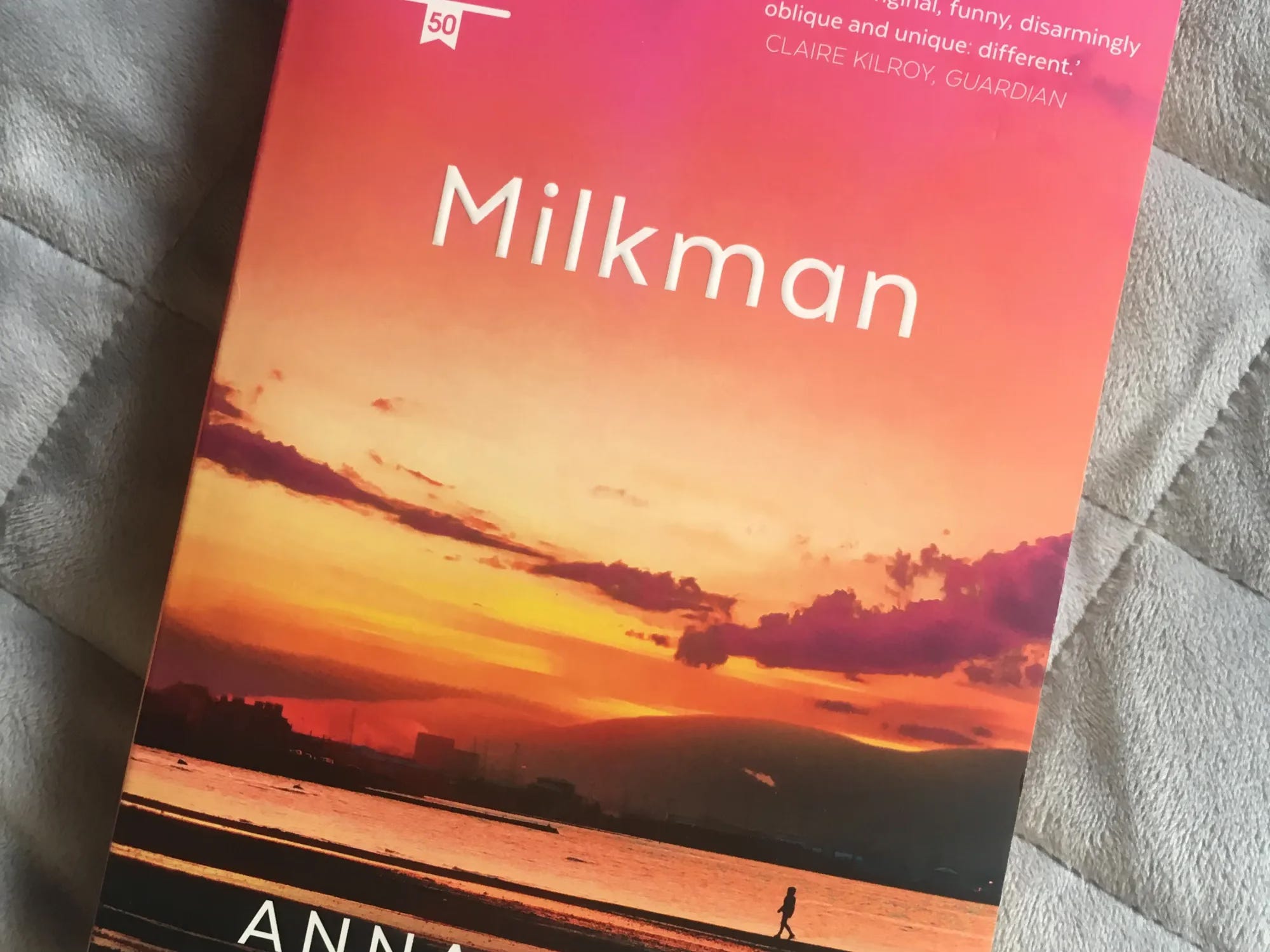
There’s been a lot of talk about this Milkman book since it won Belfast born writer Anna Burns the Booker Prize. When I suggested on Facebook that I was going to read it friends threw in their opinions. Some had given up after 20 pages and wished me good luck. Others thought it was the best writing they had ever read. So, over new year, by the coast, I invested my time in starting and finishing (YEH!) Milkman!
I honesty felt that Burns has read Tony Macauley’s brilliant Belfast memoirs and decided to write a similar book in as different a style as she could. At times, particularly the humorous bits, this reads as a complicated Macauley!
I will not lie, the style is obtuse. It takes time to get into. It takes resilience at different times to keep going. It took me a good few days to get through and I was delighted to have gotten to the end. Yet, in the days since I finished it my mind has been reeling with its content. It is worth the investment.
Let me start with the obvious. Milkman is set in a Republican area of Belfast in the late 70s. The paramilitaries are in charge of the area and the human cost of The Troubles, physically and psychologically is massive. Into this claustrophobic intensity, our narrator finds some sense of resistance by reading books while walking - 19th century books because she hates the 20th century!
Her attempts to stay aloof from the intimidation and violence prove in vain as one of the main “renouncers” - as the paramilitaries are named - takes a fancy to her. She is 18 and he is in his 40s. His flirting is all sinister and harassing. The plot for all kinds of side stories is set around this.
So, what is the return on my investment? Well, first up is the insight to what life was like in a Republican area during The Troubles. As a middle class Protestant I had no idea what everyone in Ardoyne or Lenadoon was suffering. I suddenly felt the constant stress and pressure on a community from within and without. The weariness. The trauma. The mental stress.
Within this we watch the workings of how the power mongers of a community work their rule. There is a wonderful scene where our narrator opens up to her mother, telling her the truth of the situation, or lack of it, with Milkman. Instead of the expected sympathy her mother simply calls her a liar! The rumours and gossip of the community has become the truth.
As I read I suddenly became aware that I had experienced similar manipulation. Gossip and rumour mongering in my own Church denomination has created a truth about me that was far from the truth. It can be very disorientating when you hear things about yourself that have been truth created to sideline you - lies in the name of truth I call it. Whether these lies made truth have been just an unfortunate game of Chinese whispers or something more sinister by the powers within my wider Church community I’ll graciously leave open to judgement but I felt I knew exactly how our narrator felt.
Anna Burns would be satisfied that I have applied her story to a wider space than a Belfast neighbourhood. It clearly is set there but her lack of specific names gives it the possibility of application in all kinds of similar neighbourhoods and communities across the world. The #MeToo campaign would find empathy here in the sexual harassment and misogyny.
So what do you do in such a dark, wearying, soul draining community atmosphere? There are various little rebels. They get damned as “beyond the pales”. A group of women seeking to stand up for women’s issues. A real milkman who seems to love nobody but stands up against the renouncers when they bury their guns in his garden. Our narrator and her reading of books.
She also goes to a French class in town. In a scene from there, the teacher asks them about the colour of the sky. The entire class cannot see any colour but blue. It becomes humorous - and there is a lot of humour in Milkman - as she has them all look out the window. It takes a while before they can see other colours.
That for me is the crux. It is like the movie The Truman Show and its great line, “We accept the reality we are given”. In communities like a paramilitary ruled neighbourhood in Belfast or a Church community or a Hollywood celebrity community. Any community. We need to watch that we are not psychologically trapped by the orchestrated gossip and rumour mongering. Fake truth. Fake values. Fake ambitions.
In Milkman, the beyond the pales survive. They find meaning, love and, best of all, freedom. They don’t need to remove themselves from the community but can find a resistance within. A resistance that can be grace forced rather than domination forced. A resistance that sees for themselves the wonder of the many colours in a sky that everyone else has been told to only see as blue.
Great review Steve and I recognise much of what you write about in terms of how hard the book was to get through. I finished Milkman a few days ago and wanted to punch the air when I got to the last full stop. It is certainly thought provoking and well written but I can't help feeling that Ms Burns made it harder than it needed to be. I enjoyed reading Trespassed by Louise Kennedy which sets a similar scene and even Harry's Game by Gerald Seymour from way back in 1980 which shows The Troubles from the perspective of an undercover British agent.